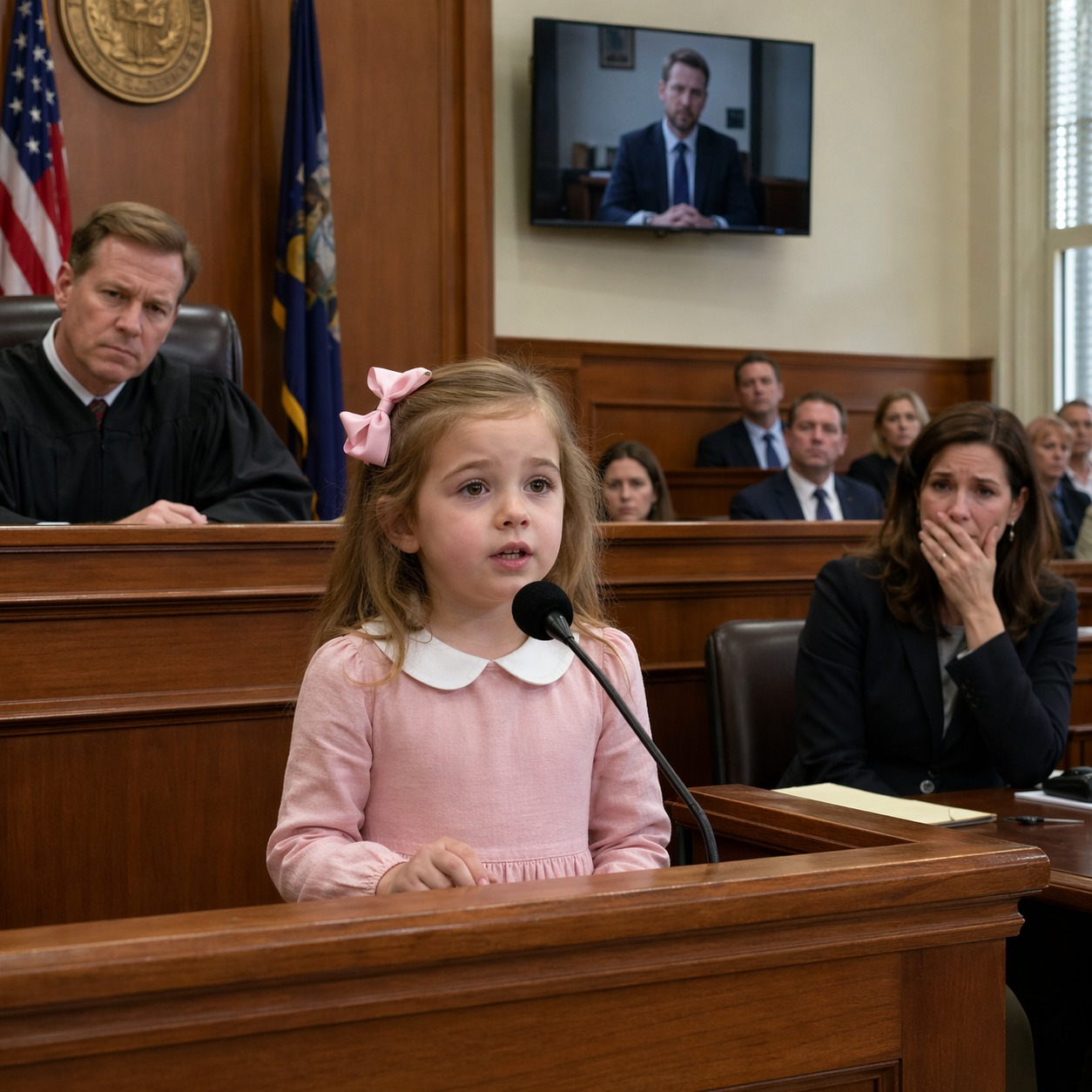
My daughter had been quieter than usual for weeks before the hearing, and I had told myself it was the divorce. Children go quiet during divorces the way animals go quiet before storms, retreating into themselves, watching the adults around them with a wary attention that looks like withdrawal but is actually something closer to surveillance. I had watched Harper pull inward through all of October and into November, speaking less at dinner, choosing her words more carefully when she did speak, studying my face when she thought I wasn’t looking with an expression I could not quite read. I had assumed she was grieving the family as she had known it. I had assumed the silence was pain finding no outlet. I was wrong about what it was. I was right that it was pain, but the silence was not resignation. It was something far more deliberate than that, and I would not understand what until she stood up in a courtroom and asked a judge if she could show him something I didn’t know about.
Caleb and I had been married for twelve years. He was the kind of man who understood how rooms worked, how to read the temperature of a conversation and adjust himself to become whatever the moment required. Charming at parties. Thoughtful with my friends. Attentive in front of our families. He had a way of occupying space that made people feel he was generous with it, as if his presence were a gift he was sharing rather than a territory he was claiming. I had loved that about him once. I had mistaken it for warmth. It took years before I understood it was performance, and by then the performance had become so seamless that challenging it felt like challenging reality itself, because everyone around us had accepted the version of Caleb he presented and nobody, including me, had the vocabulary to describe what was underneath it.
What was underneath it was control. Not the loud kind. Not the kind that leaves marks or raises voices or provides the obvious evidence that makes other people take your side. His control was architectural. It lived in the structure of our finances, in the way he managed information, in the subtle redirection of conversations so that my concerns always ended up sounding unreasonable by the time he was finished rephrasing them. He handled our money with the focused precision of someone building a case, and when I asked questions about accounts or expenditures, he answered in a tone that was patient on the surface and condescending underneath, the tone of a man explaining something simple to someone who should already understand it. Over time I stopped asking. That was the point. The architecture was designed to produce exactly that silence.
When he filed for divorce, I was not surprised. I was relieved, which is a different thing, and then immediately frightened, because relief in the context of someone like Caleb meant that the worst part was not ending. It was beginning. He wanted full custody of Harper. He wanted the house. He wanted the financial settlement structured in a way that I was certain, but could not fully prove, was built on hidden assets and accounts he had moved beyond my reach. His attorney was expensive and sharp. My attorney was competent and doing her best. And Caleb walked into the proceedings with the same calm, generous, fatherly bearing he brought to everything, sitting with his back straight, his jacket perfectly fitted, looking at the judge with the patient expression of a man who simply wanted what was best for his daughter and could not understand why his emotional, unstable wife was making this so difficult.
I had spent months feeling like I was drowning in a room full of people who could not see the water. Every claim I made sounded, when Caleb’s attorney was finished reframing it, like the complaint of a woman who was vindictive, disorganized, and incapable of the clear thinking that custody required. I had tried to raise the issue of a hidden account. I had documentation that was incomplete because Caleb moved money with obsessive care and because every trail I followed ended at a wall he had built before I got there. My attorney presented what we had. Caleb’s attorney dismissed it as paranoid speculation driven by marital resentment. The judge listened with the measured patience of someone who has heard a thousand versions of the same story and who has learned to wait for the facts to sort themselves from the noise.
The morning of the hearing, I sat at the table beside my attorney and tried to keep my hands still. Caleb sat across the room with his lawyer, composed and unhurried, radiating the particular confidence of a man who believes the outcome has already been decided in his favor. Harper was in the gallery with a court appointed advocate, a small figure in a blue dress with her hair pulled back, holding a tablet in her lap the way you hold something you have been carrying for a long time and are finally ready to set down.
I did not know about the tablet. I did not know what was on it. I did not know that my ten year old daughter had spent weeks building something she called, in the folder name she gave it on the device, “For when I no longer believe you.”
The hearing moved through its early stages with the procedural rhythm I had grown accustomed to over months of legal proceedings. Caleb’s attorney made her arguments. My attorney made ours. Financial documents were presented and contested. Character was discussed in the careful, coded language that courtrooms use to avoid saying directly what everyone in the room understands. Caleb’s attorney described me as emotionally reactive. My attorney described Caleb as financially controlling. The judge listened, asked questions, made notes. The morning felt like wading through something thick and gray, a process that was technically about Harper’s wellbeing but that had become, in practice, a contest between two adults’ competing versions of reality, with the child herself sitting quietly at the edge of the room as if she were a footnote in her own story.
Then Harper stood up.
She did not ask permission in the conventional way. She did not raise her hand or wait to be acknowledged. She simply stood, holding the tablet against her chest, and said, in a voice that was small but steady and aimed directly at the judge, “Your Honor, can I show you something my mom doesn’t know about?”
The room went still. My attorney looked at me. I looked at Harper. Caleb’s posture changed. It was a small shift, barely visible if you were not watching for it, but I had spent twelve years learning to read the microscopic adjustments in his bearing that signaled the difference between confidence and alarm. His shoulders tightened. His jaw set. His eyes moved to Harper with an expression that was not anger, not yet, but something preceding anger, the look of a man who has just realized a variable he did not account for.
“Harper,” he said. His voice carried the warm, fatherly tone he used in front of other people, but there was a thinness behind it now, a thread being pulled too tight. “Sweetheart, this isn’t the time.”
Harper looked at him with a seriousness that did not belong on a ten year old’s face. “You told me the judge needed to know the truth,” she said.
Something broke in Caleb’s expression. Not dramatically. Not in a way that anyone who did not know him would have noticed. But I noticed. The mask shifted, just slightly, and behind it I saw the man I had been trying to describe to attorneys and judges for months, the man nobody believed existed because he was so good at not existing in front of witnesses.
“Harper,” he repeated, and this time the false sweetness was gone. “Don’t do this.”
Caleb’s attorney stood so quickly she nearly knocked over her chair. “Your Honor, this is clearly inappropriate. The child is being influenced, and whatever she has been told to present.”
“Sit down, counselor,” the judge said.
Her voice had changed. For the first time all morning, it sounded less procedural and more human, the voice of a woman who had been listening carefully and who had just heard something that made her want to listen more carefully still.
I could not breathe properly. I did not know what video Harper had. I did not know what she had seen. All I knew was that my daughter had been carrying something in silence for weeks, and that the silence had not been the withdrawal I assumed. It had been preparation.
The judge looked at Harper. “I want to see what you have. But first I need you to tell me one thing. Why did you save it?”
Harper swallowed. Her fingers gripped the tablet as if it were the only solid thing in the room.
“Because I thought if I showed it to Mom, she’d cry again. And I didn’t want her to cry anymore because of Dad.”
The courtroom went silent. Not the procedural silence of people waiting for the next motion. A different silence, heavier and more human, the silence that falls when a child says something so plain and so true that the adults in the room are momentarily unable to match it.
The judge nodded slowly. She spoke quietly with both attorneys and decided the initial review of the video would take place in her chambers, with only the parties, their counsel, and the judge present. There was no need to expose Harper further than the moment had already required. Caleb tried to object, but his voice had lost its authority, the way a voice loses authority when the person speaking knows that what is about to be revealed cannot be managed or reframed.
“This is ridiculous,” he said. “It’s nothing.”
The judge turned to him with a look that had a cutting precision I had not seen from her before. “That is precisely why I am interested in what you don’t want me to see.”
We went into chambers. I remember the sound of the door closing behind us. The atmosphere changed immediately, the way atmosphere changes when the formal structure of a courtroom is replaced by the smaller, more exposed space of an office where there is nowhere to project and nowhere to hide. The judge sat behind a desk. Harper, with trembling hands, gave her the tablet.
“It’s in the folder that says ‘For when I no longer believe you,’” she whispered.
The judge opened it.
The video was blurry, slightly tilted, clearly recorded from a shelf or a high surface by someone small enough that reaching the device had been an act of physical effort. It took me two seconds to recognize the room. Our living room. The low table. The gray armchair. The window that looked out over the garden. The date stamp in the corner read three weeks before Caleb had filed the divorce papers.
He was standing near the sofa, a glass in one hand, his phone pressed to his ear. He was not alone. Seated on the sofa, in a silk robe, was Vanessa, the woman Caleb had described to me and to his attorney and to the court as a financial advisor who was helping him reorganize our family investments. She was there in our living room, at ease, familiar with the space in a way that made the word advisor dissolve into its obvious replacement.
Caleb was laughing on the phone. Not with warmth. With that dry, dismissive laugh he used when discussing people he had already decided were beneath him.
“No, I’m telling you, it’ll be easy,” he said. “Harper will repeat whatever you need if you’re patient. You just have to convince her that her mother gets sad, that she yells sometimes, that she forgets things. Normal stuff. Nothing too dramatic.”
I felt the air leave my lungs. I leaned forward in my chair.
Vanessa laughed. Caleb lifted his glass.
“Don’t call it bribery,” he said. “Call it stability.”
The image shifted slightly, a faint crackling sound, as if Harper had barely moved the device on whatever shelf she had placed it. My daughter had been there. She had been in the room, or just outside it, close enough to hear, close enough to record. She had listened to her father describe how to coach her into undermining me, and she had not cried, had not confronted him, had not come to me. She had saved the evidence. Silently. Alone. At ten years old.
The video continued. Caleb put his glass down and lowered his voice.
“With full custody, the house is easier to keep, and I don’t have to divide the assets the way she thinks. Besides, with her emotional instability, the judge won’t give her anything close to equal time.”
Vanessa looked at him. “What if your daughter changes her mind and says something?”
Caleb shrugged. “She won’t. She’s terrified of disappointing me.”
That sentence went through my chest like something physical. I looked at Harper. She was not watching the screen anymore. She was watching me. And in her face I saw something I had not understood until that moment. She had not recorded the video to protect herself. She had recorded it because she knew no one would believe me. Because a ten year old girl had watched the world organize itself around her father’s version of reality and had understood, with a clarity that shames every adult in this story including me, that the only way to break through that version was evidence that could not be reframed.
The video was still playing. Caleb mentioned the financial arrangement, the hidden accounts, the strategy for making my spending look erratic while his own transfers remained invisible. My attorney intervened quietly: “Your Honor, those expenditures correspond to the household maintenance account that my client documented and that Mr. Dawson partially emptied in cash over six months.” The judge raised a hand. She wanted to hear the rest.
Vanessa asked about something she called the Arizopa account. Caleb smiled. “According to the court, that account doesn’t exist.” My attorney and I looked at each other. The Arizopa account was exactly what I had suspected for months, the hidden structure I had tried to prove and failed because Caleb moved money with the precision of someone who had been planning this long before the word divorce was ever spoken.
Vanessa asked what would happen if I found out. Caleb let out a laugh so casual it sounded like he was discussing a television show. “She won’t discover anything. She’s always been more sentimental than intelligent. She cries, falls apart, then apologizes. It’s predictable.”
The judge stopped the video. She did not make any dramatic gesture. She placed the tablet on the desk, removed her glasses, and looked first at Harper, then at me, then at Caleb. I have never in my life seen someone drain of color so completely while remaining upright.
“Do you wish to say anything, Mr. Dawson?” the judge asked.
Caleb opened his mouth. For a moment nothing came out. Then he said the only thing he had left: “It’s taken out of context.”
It was a small sentence. A defeated sentence. The kind of sentence people reach for when they have spent years constructing a narrative and have just watched it collapse in real time. The judge did not respond immediately. She played the video again. Caleb’s voice filled the office a second time: “She’s terrified of disappointing me.” And now nobody in the room could pretend they were breathing normally.
The judge paused the recording. She leaned forward, both hands on the desk.
“I’ve heard enough.”
Caleb’s attorney tried to speak. The judge did not let her finish. “Your client has engaged in a deliberate strategy of custody manipulation, coached testimony from a minor, and concealment of financial assets. I am ordering an immediate stay on all sole custody requests. I am ordering an emergency forensic accounting review. I am ordering an independent psychological evaluation for the child.” She turned to my attorney. “File for precautionary measures today. I will grant them.”
Then she looked at me. Not with pity. With something more valuable than pity. With credibility. The thing I had been trying to earn for months in rooms full of people who found it easier to believe Caleb’s version than mine.
“Mrs. Dawson,” she said, “I am sorry that your daughter had to bring this into my office for what you have been trying to say to be understood.”
I felt something inside me, something that had been held together with wire and willpower for months, finally release. Not collapse. Release. The difference matters. Collapsing is falling apart because you cannot hold on any longer. Releasing is setting something down because you no longer have to carry it alone.
Caleb turned toward Harper with an expression that made me stand up instinctively. It was not just anger. It was betrayal, the particular outrage of a man who has been operating under the assumption that he controls everyone around him and who has just discovered that the person he controlled least was the smallest person in the room.
“You recorded that?” he said.
Harper, small as she was, held his gaze. “Yes.”
She did not cry. She did not look away. And that was the image that broke me and rebuilt me in the same moment: my ten year old daughter, standing in a judge’s chambers in a blue dress, doing alone the work that every adult around her had failed to do in time. She had seen the lie. She had understood that the lie was winning. And she had decided, by herself, with no guidance and no protection and no guarantee that anyone would believe her, to build a record of the truth and carry it until the moment it could be heard.
I do not know what I looked like. I do not know if I cried or went pale or simply stood there absorbing the weight of what my child had done. I know that when the judge finished giving her orders and the attorneys began gathering their papers, Harper took a step toward me, and in that step she stopped being the quiet, watchful girl who had carried an adult burden for weeks and became, again, just a child who needed her mother. I knelt before she reached me and pulled her against my chest with a force that ached in my arms.
“I’m sorry I didn’t tell you sooner,” she whispered against my neck.
I closed my eyes. “No, sweetheart. I’m sorry I left you alone with something that big.”
She rested her head on my shoulder. Her body was shaking, the fine tremor of a child who has been holding herself rigid for a very long time and has finally been given permission to stop.
We stayed like that on the floor of the judge’s chambers while the room emptied around us. Caleb left first, moving quickly, his attorney close behind him, neither of them speaking. My attorney touched my shoulder once and said she would call me that afternoon. The judge’s clerk closed the door softly on his way out, and then it was just the two of us, my daughter and me, kneeling on the carpet of an office that smelled like paper and old coffee, holding each other in the silence that comes after something has finally been said.
The weeks that followed moved with the particular momentum of a legal process that has been given new evidence and new urgency. The forensic accounting review found the Arizopa account within days. It contained nearly two hundred thousand dollars that Caleb had moved in increments small enough to avoid automatic detection, routed through three intermediary accounts, and parked in a structure designed to be invisible during asset disclosure. His attorney withdrew from the case. His custody petition was denied. The financial settlement was restructured under court supervision with terms that reflected what the judge now understood about how Caleb operated.
I do not take pleasure in describing his undoing. I take something quieter than pleasure and more durable. I take the knowledge that the truth, which I had been trying to speak for months in rooms where no one was willing to hear it, was finally audible. Not because I found the right words. Because my daughter found the right evidence.
Harper started seeing a therapist in December, a woman named Dr. Adeyemi who specialized in children who had been placed in the middle of adult conflicts and who had learned, out of necessity, to carry responsibilities that should never have been theirs. The sessions were private, and I did not ask Harper what she discussed. I only asked, each week when I picked her up, whether she felt okay, and she said yes with increasing conviction as the weeks passed, and I believed her because the evidence supported it. She was sleeping better. She was talking more. She was drawing again, elaborate scenes of castles and forests and rivers that she taped to the refrigerator with the confident asymmetry of a child who has decided that the surfaces around her are safe enough to mark.
One evening in January, after dinner, she was doing homework at the kitchen table and I was washing dishes, and she said, without looking up from her math worksheet, “Mom, I don’t feel like I have to watch anymore.”
I turned off the water. “Watch what?”
“Everything.” She erased something and blew the shavings off the page. “I used to watch everything all the time. Like if I stopped paying attention something bad would happen and I wouldn’t have proof.”
I dried my hands and sat down across from her. “And now?”
She looked up. Her eyes, brown and serious and so much older than ten, held mine for a moment. “Now I don’t think I need proof anymore. I think people just believe us now.”
I reached across the table and put my hand over hers. She let me hold it for a few seconds, then pulled away gently and went back to her math, and I sat there watching her work, watching her erase and rewrite and move on to the next problem, and I thought about the folder she had named on that tablet, the folder that contained the video that had changed everything, the name she had chosen for it with the devastating precision of a child who had learned too early how truth works and how lies work and what it costs to carry the difference between them in secret.
For when I no longer believe you.
She had believed him once. She had believed her father when he told her things about me, believed him when he said the truth needed to come out in court, believed him when he said the judge should know everything. And then she had heard him on the phone, laughing, planning, describing her as a tool and me as a predictable weakness, and the believing had stopped. Not with drama. Not with confrontation. With a quiet, solitary decision to open a folder on a tablet and press record and wait until the moment came when what she had saved could do what she could not do alone.
She was eleven now. She had lost a tooth last week and complained about the injustice of the tooth fairy’s exchange rate. She had joined a soccer team and was, by her own assessment, “not terrible.” She had a best friend named Lila who came over on Saturdays and they made elaborate bead bracelets on the living room floor while I pretended not to notice that they were also eating popsicles on the carpet. She was a child. She was being allowed, finally, to be one.
Some evenings, after she went to bed, I sat alone in the kitchen and thought about what she had done. Not with pride, though I was proud. Not with gratitude, though I was grateful. With something closer to sorrow, the particular sorrow of a mother who understands that her daughter’s bravery was produced by a failure of protection, that Harper had to become her own witness because the adults responsible for her had not managed to be adequate ones. She should not have needed to carry that. She should not have needed to build a case at ten years old while the grown ups around her argued about paperwork. The fact that she did, and that it worked, does not make it right. It makes it necessary. And the distance between right and necessary is the space where most of the real grief in this story lives.
But she is okay. That is the sentence I come back to. She is okay. She sleeps through the night. She laughs at the dinner table. She does her homework and argues about bedtime and leaves her shoes in the hallway where I trip over them, and each time I trip I feel something that is not annoyance but its opposite, the small, daily evidence that a child is living in this house without vigilance, without the need to watch and record and prepare, without the weight of a secret she was never supposed to carry.
Last Sunday she was sitting on the kitchen floor making a bracelet for Lila, beads spread around her in a wide, colorful arc, and she looked up and said, “Mom, can we get a dog?”
I looked at the beads on the floor, at the popsicle wrapper she had not yet thrown away, at the math worksheet from Friday still on the counter, at the small, ordinary mess of a child’s life spreading comfortably through a house that finally felt like it belonged to us.
“We’ll talk about it,” I said, which is what parents say when the answer is probably yes but they need a moment to catch up to the fact that the life they are living has become, against all odds, the kind of life where getting a dog is the biggest question on the table.
She grinned and went back to her bracelet, and the kitchen was quiet except for the small click of beads being threaded onto string, and outside the window the evening was coming on soft and blue, and I stood at the counter and let the ordinariness of it wash over me like something I had earned.